
The secret zero problem: every secrets manager still needs one handoff
Every secrets manager needs one first credential delivered by hand, and it is the one most likely to end up in a chat window. Why that happens, how machines avoid it, and how to hand it to people safely.
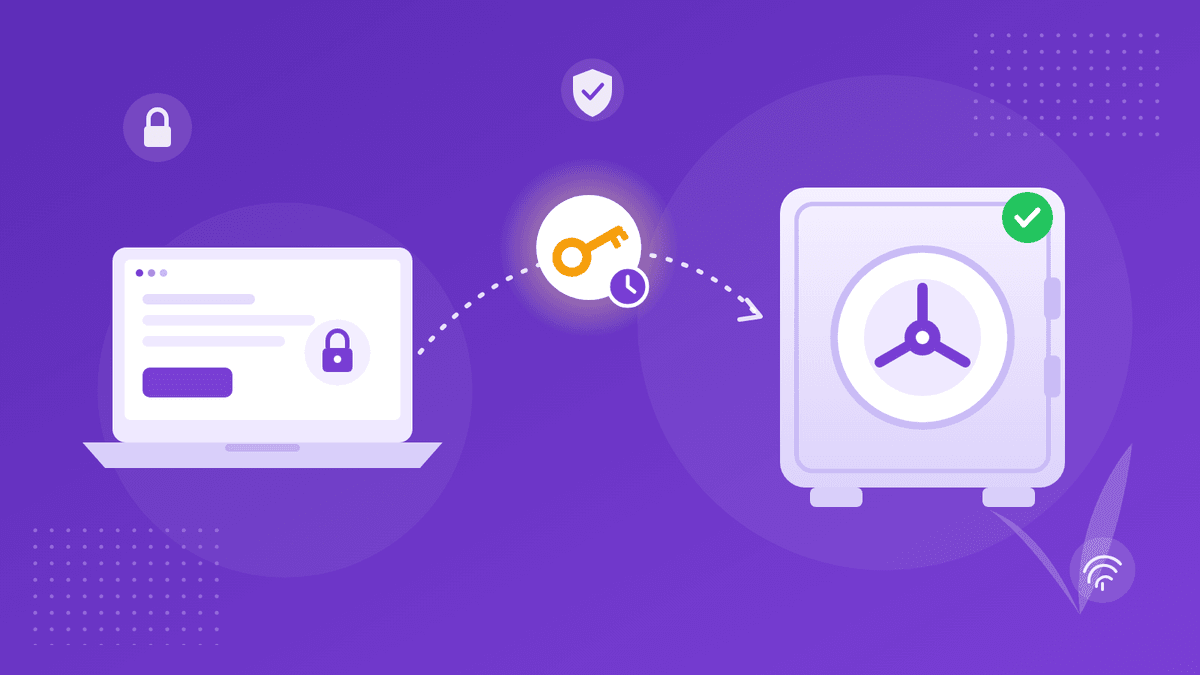
Picture a team that has done everything right. Production secrets live in a secrets manager. CI pulls them at runtime. Nobody commits a .env file any more, and a dashboard shows who read what, and when. Then a new engineer joins, and on their first morning someone opens a direct message and pastes in a token, "just to get you set up".
That token is secret zero: the one credential a secrets manager can't hand out for you, because you need it before the secrets manager will talk to you. Every vault, every encrypted .env and every secrets platform has one somewhere. It is also the credential most likely to travel through the very channels the rest of the setup was built to avoid.
What is the secret zero problem?
A secrets manager is a gatekeeper. Before it releases anything, it has to know who is asking, so every client needs a credential before it can get credentials. HashiCorp's Vault documentation calls this the secure introduction challenge, and describes it simply as getting the first secret to the consumer.
The problem takes a different shape in every stack. It is the token a new server uses to log in to Vault, Doppler or Infisical for the first time. It is the private key that decrypts an encrypted .env, which dotenvx keeps in .env.keys or your system's secret store, deliberately outside git. It is the cloud access key a CI job uses to reach production, and the first password a contractor uses to reach your staging environment. Tooling can gather all your secrets into one well-protected place, but it can't deliver its own first key. That is one reason .env contents and API keys can still end up in Slack threads at companies that already pay for a secrets manager: the sync problem is solved, but the introduction problem isn't.
Why does the first secret leak more than the others?
Secret zero is handled differently from every secret that comes after it. Day-to-day secrets flow through automation, with access policies and an audit trail. The first one is set up by hand, once, usually by a senior engineer under time pressure, who reaches for whatever channel happens to be open. Chat, email and tickets are all built to keep messages, which is exactly the wrong property for a credential.
It also tends to be the most powerful credential in the room. Because it bootstraps everything else, it is often issued with broad permissions: the token that brings up a server can usually read far more than that server will ever need. And because nobody wants to repeat a manual setup, it is rarely rotated. The result is a long-lived, over-privileged credential whose delivery left no trace in the system that is supposed to track it. The secrets manager knows exactly who read each secret. The direct message that delivered its own token appears nowhere in that history.
How do machines avoid secret zero?
For machines, the strongest answer is to remove the secret altogether and let the platform vouch for the workload.
Cloud providers already do this. AWS recommends attaching IAM roles to applications on EC2: the role hands the application temporary credentials through an instance profile, so you "don't have to distribute long-term credentials" to the instance at all. Azure and Google Cloud offer equivalents. CI systems have followed. GitHub Actions can exchange a token from its own OpenID Connect provider for a short-lived cloud access token, and GitHub's documentation is explicit about the benefit: no cloud secrets stored as long-lived GitHub secrets, and a token that is valid for a single job and then expires.
Secrets managers support the same idea. Vault's secure introduction guide describes a platform integration model, in which Vault trusts AWS, Azure or Google Cloud to confirm a client's identity. It also describes a trusted orchestrator model, in which a tool that is already authenticated, such as Terraform, introduces each new machine. If your workloads run somewhere that can prove who they are, secret zero disappears for them, and that is the path to take first.
Where does secret zero remain?
Platform identity stops at the edge of the platform. People don't have instance profiles. A new hire's first credential, a contractor's staging login and a vendor's API key all start life as something one person has to give to another. So does the development key for an encrypted .env on a laptop. Plenty of machines have no cryptographic identity to lean on either: on-premises servers, some virtualisation platforms (Vault's documentation points out that VMware provides none), and most third-party SaaS. And every secrets manager starts with an administrator who has to receive the first admin credential somehow.
For all of these, the question is not whether a person will hand over a secret. It is how carefully they do it.
How do you hand over secret zero safely?
Treat it as the most sensitive handoff you make, because it is. Start by making the credential smaller before it moves. Vault's AppRole and response-wrapped tokens, Doppler's expiring service tokens and per-environment dotenvx keys all exist so that a bootstrap credential can do one thing, for one environment, for a short time. A token that can enrol a single machine and then expires is a very different risk from a root token that lives for years.
Then deliver it through something designed for delivery rather than conversation. An encrypted link that expires after one view or a few hours, with a passcode sent through a second channel, leaves nothing readable behind in anyone's message history. It can also give you a record: when the link was opened, from where, and whether the open came from a person or from a link scanner checking the URL. Once the machine or the person has its long-term access, revoke the bootstrap credential and write down who received what. Offboarding only works for credentials you can list.
This is the gap CredenShare is built for. Shares created in the web app are encrypted in your browser (those created from Slack are encrypted on our servers), they expire by time or by number of views, and they can carry a passcode. Paid plans add an access log that labels link scanners, and activity emails on every plan tell you when a share is opened. It doesn't replace your secrets manager, and it shouldn't: once secret zero has been delivered, the secrets manager takes over. If what you are sharing is a whole .env file rather than a single key, our guide to sharing .env files with your team works through when you need a sync tool and when you need a one-off handoff.
The takeaway
A secrets manager protects every secret except the first one, and that first handoff is where a careful setup most often meets a chat window. Remove secret zero wherever the platform can vouch for the workload. Where it can't, make the handoff deliberate: scoped down, short-lived, delivered by a link that expires, and revoked once its job is done.
Sources (checked on October 25, 2026):
HashiCorp: Secure introduction of Vault clients ·
GitHub: OpenID Connect in GitHub Actions ·
AWS: IAM roles for applications on EC2 ·
dotenvx ·
Doppler CLI: ephemeral service tokens
Product names are trademarks of their respective owners. CredenShare is not affiliated with them.
Hand off the first secret as a link that expires
Free plan: 3 shares a day, encrypted in your browser.
Written by
CredenShare
The CredenShare team writes about secure credential sharing, password management, and enterprise security best practices.