
Secure Handoffs in Real Work
A field guide from request to close-out
Follow a credential through the decisions around a real task, from request to close-out.
Secure handoffs in real work
FIELD GUIDE • FROM REQUEST TO CLOSE-OUT
This guide follows a credential through the decisions that surround a real task. It is for support leads, implementation teams, IT owners and technical reviewers who need a repeatable process rather than another explanation of why passwords matter.
You will leave with an access decision, an operating route, a fallback, a close-out owner and a conclusion you can support. Each chapter contains a concrete action; none requires you to paste a live secret into a worksheet or purchase a tool.
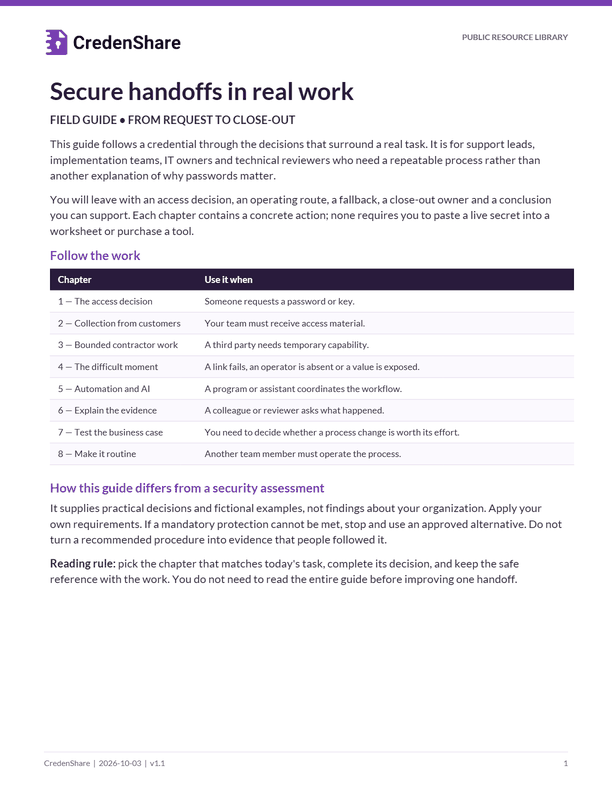
Follow the work
| Chapter | Use it when |
|---|---|
| 1 — The access decision | Someone requests a password or key. |
| 2 — Collection from customers | Your team must receive access material. |
| 3 — Bounded contractor work | A third party needs temporary capability. |
| 4 — The difficult moment | A link fails, an operator is absent or a value is exposed. |
| 5 — Automation and AI | A program or assistant coordinates the workflow. |
| 6 — Explain the evidence | A colleague or reviewer asks what happened. |
| 7 — Test the business case | You need to decide whether a process change is worth its effort. |
| 8 — Make it routine | Another team member must operate the process. |
How this guide differs from a security assessment
It supplies practical decisions and fictional examples, not findings about your organization. Apply your own requirements. If a mandatory protection cannot be met, stop and use an approved alternative. Do not turn a recommended procedure into evidence that people followed it.
Reading rule: pick the chapter that matches today's task, complete its decision, and keep the safe reference with the work. You do not need to read the entire guide before improving one handoff.
1 — Start with access, not the password
A request that says “send the credentials” often leaves the important questions unanswered. What operation is needed? Which environment? Who approves it? How long should the ability to act remain?
The five-line brief
Write the task, issuing system, authorized recipient, minimum capability and end condition. For example: “Read staging configuration for CASE F-401, approved by the system owner, using temporary read-only access, ending after verification or the approved deadline.”
That brief says more than “share the admin key,” without exposing anything sensitive.
Prefer an alternative when it fits
Named access and delegated permissions can avoid transferring a reusable secret. A machine integration may belong in an approved runtime secrets manager. A password manager may already cover the internal human-access need. A temporary transfer tool addresses the handoff step, not every form of access management.
Do not choose a product first and force every workflow through it. Conversely, possessing a password manager does not establish that a customer-collection process is already solved. Inspect the actual task and recipient experience.
A useful refusal
I can help with the task, but a personal or broad administrator password is more access than we have approved. Please identify the required operation and the owner who can authorize a narrower route.
Your output
One of three decisions: no transfer needed; a specific approved transfer is needed; or the owner must resolve scope. Keep the decision with the case. It is acceptable to stop before creating any share.
Boundary: a familiar name, a logo, a chat message or an urgent deadline is not sufficient authorization. Verify material or unexpected requests through an established independent contact route.
2 — Receive information without inviting oversharing
When a customer provides integration access, the design of your request shapes what comes back. Asking for “all credentials and any useful notes” encourages unnecessary disclosure and makes review harder.
Ask for the narrow task
Explain the purpose, environment and required scope. Tell the customer not to submit personal passwords, recovery material or unrelated production access. Name the approved collection route and explain how to verify an unexpected request.
Keep collection and reading distinct
A route that accepts a submission is not the private route that reads it. In CredenShare, the Collect link and the Access link have distinct purposes. Distributing the private access material as if it were a form link is a different and consequential mistake. [C1]
Acknowledge without echoing
We received the information for [case]. It will be used only for the approved task. Please do not repeat the value in this conversation. We will confirm completion using the case reference.
If the value cannot be used, describe the non-sensitive failure and ask for a verified correction through the approved route. Do not attach a screenshot of the credential to explain the problem.
Plan the next location
Decide whether the authorized worker uses the material once or stores it in an approved secrets system for a continuing integration. A temporary handoff is not a durable storage plan. Set the owner of source access and its end/review condition before the work disappears from the ticket queue.
Your output
A scoped request, a private reading route held by the authorized operator whose account created the request, a safe acknowledgment, and a named destination/closure owner. Rehearse the process with disposable information before using it for a critical workflow.
[C1] CredenShare Secure Requests. Creating Secure Requests is offered on Business and Enterprise plans. Only the account that created a request can open its submissions; team owners and admins cannot, and that access cannot be delegated.
3 — Treat contractor access as a bounded grant
A contractor may receive a secret in seconds and retain its underlying capability long after the project ends. Put the grant and closure decision in the task, not only in the delivery settings.
At the start
Record the scope, intended recipient and deadline. Choose a named temporary account or scoped token where practical. Identify dependencies before using a shared credential. State where the material may be stored and whether onward sharing is prohibited.
At the end
The project owner confirms the task's disposition. The issuing-system owner performs and verifies the required revocation, replacement, disablement or permission change. The handoff operator retires the delivery route separately.
A recipient's acknowledgment is useful reported information; it is not proof of source revocation or destruction of every copy. Distinguish active sessions and derived access where they matter to the service.
When work continues
Require a new approval and review date. Do not infer authorization from a new delivery link. An approved extension is still active access and must remain visible.
When a dependency blocks closure
Document the system/job affected, replacement action, owner and next check. Mark an exception rather than pretending that the access is closed. Follow incident priority when continued access presents an urgent concern.
Your output
A closure record that another authorized person can interpret without retrieving the credential. Use the separate access close-out register supplied with the companion checklist; its fictional example is teaching data, not evidence to copy into your own record.
Useful question: “Who can show that the issuing system ended the approved access?” If the answer is only “the sharing link expired,” the close-out is incomplete.
4 — Design the fallback before it fails
People are most tempted to bypass controls when the safe route becomes inconvenient. A short retrieval window, a missing device, a forgotten passphrase or an untested backup operator can turn a routine task into an unsafe workaround.
Use a failure rehearsal
With disposable data, show an unavailable handoff and ask the operator what to do. The correct response identifies the owner, checks the non-sensitive error and uses a verified reissue or approved alternative. It does not paste the value into a ticket.
Check the actual key-custody and other-device behavior. Client encryption and recoverable custody are separate concerns; do not assume role membership supplies every recovery ability. [C2]
When the credential is exposed
Stop redistributing it, involve the system/security owner, identify the scope and dependencies, and carry out approved containment. Preserve necessary evidence in restricted storage. Deleting the message does not establish that access has ended or that no one used it.
Avoid a destructive guess
Before expiring or deleting a request, confirm whether received responses still need authorized handling. In the CredenShare app, expiring or deleting a request destroys the content of every submission it still holds, so open each one still needed and move the value to its approved destination first. Before resetting keys, understand the recovery consequence. Before rotating shared credentials, understand the dependencies or follow the incident lead's urgent containment decision.
Your output
A fallback instruction that states who can authorize the next step and what information may be shared while troubleshooting. Test it with the person expected to use it during an absence.
Case [reference]: we attempted [operation] and saw [non-sensitive error] at [time/timezone]. No credential or live reading link is attached. Please advise the approved next action.
[C2] Zero-Knowledge Custody. This chapter is original operating guidance, not a record of a completed recovery test.
5 — Automate the work, not the authority
A script can create or coordinate a handoff, but it cannot decide on its own that a person should receive a credential. Keep permission, tenant identity and permitted operations in deterministic application checks.
A narrow integration pattern
Store the case and operation reference before an external create. Generate and protect the required local key material. Submit the documented request using a scoped credential. Keep private reading material out of ticket fields, logs and model messages. Return only the approved collection route or sanitized result appropriate to the task.
A timeout may mean the operation succeeded but the response was lost. Preserve the same operation state and reconcile; do not generate fresh keys and create another request blindly. The companion developer recipe shows this discipline for creating a share rather than a request (the SDKs cover shares only), in a local mock and an explicitly guarded SDK path. Its mock tests are not a live-service certification.
AI-assisted work
The model should receive a safe case reference and typed result. The restricted runtime can use the credential for the allowed operation without exposing it to model context. Reject arbitrary destinations, account references and commands supplied by retrieved content.
For consequential actions, bind approval to the exact recipient, account, environment and input revision. Recheck before execution. A changed proposal needs a changed approval.
Your output
A small contract: permitted input, server-side authority check, restricted secret handling, safe output, log policy and timeout/retry behavior. Test the error path as carefully as success.
Further reading: CredenShare request API; OWASP AI Agent Security. Recommended application boundaries are not automatic capabilities of the sharing service.
6 — Explain one case accurately
A reviewer may ask how the process operated. The strongest answer is a scoped conclusion with evidence references and limitations, not a folder full of screenshots or a claim that a policy proves every employee complied.
Build the evidence chain
| Evidence | Question it can help answer |
|---|---|
| Approval | Was the recipient, purpose and access scope authorized? |
| Selected configuration | Which controls were chosen for this specific handoff? |
| Operational observation | What activity was recorded, by which source and within what coverage? |
| Completion acknowledgment | What did the responsible person report about the task? |
| Issuing-system record | What source-access action was performed or verified? |
An unavailable artifact remains a gap. Do not fill it with an expected successful result. A sample explains the sample, not the full organization.
Use restrained wording
For [case], the references support [specific observations]. We inspected [scope/window]. [Event] was reported by [role]; [event] was directly verified through [source]. Unresolved limitations: [specific]. Follow-up: [owner/date].
Keep product log scope visible
CredenShare's detailed audit guide describes creator-scoped exports and the refused opens that leave no row, such as IP, expiry and login refusals. Secure requests write no access-log rows, and opening a submission in the request's viewer adds none. Do not call that complete organization-wide visibility. Check which account, readable period and truncation limit apply. [C3]
Your output
One short packet index and one conclusion another authorized reviewer can follow. Keep the actual secrets and live reading links out of the packet. For a formal examination, confirm the relevant customer control and evidence requirement with the responsible reviewer.
[C3] Policy and Audit. The evidence method is original guidance; it is not a universal SOC 2 control mapping.
7 — Compare effort without inventing ROI
A process change may release staff time, improve consistency or reduce uncertainty. Those benefits are not automatically cash savings. Compare a defined baseline with a measured pilot and make the assumptions visible.
Measure the same work
Count handoffs consistently. Include active preparation, handling, follow-up and closure effort. Track waiting time separately. Include errors and rework, not only successful cases. Record added administration and training maintenance.
Keep three outputs distinct
Capacity change: the difference in staff hours required for a stated volume.
Modeled labor value: that capacity multiplied by an approved loaded-cost assumption, less actual recurring cost changes.
Cash-only balance: costs that genuinely stop minus new cash costs. A worker having more time is not necessarily a payroll saving.
Decide with the full result
A positive labor-valued result and a negative cash-only result can coexist. The owner can still choose to invest for capacity, service quality or control reasons, but should say which reason applies. A process that becomes slower may need redesign rather than better marketing.
The companion browser calculator starts blank, provides a labeled hypothetical example, and exposes its formulas. It excludes tax, financing, discounting and annual-payment timing. Use a dated cash schedule when payment timing is the issue.
Your output
A bounded decision: continue, change the troublesome step, or stop. State what would change that decision after the next review. Do not create a breach-cost estimate simply to make a purchase look worthwhile.
Practical wording: “For this workflow and volume, the pilot suggests [result] with [limitations]. Our reason to proceed is [capacity/control/service], not an asserted guaranteed cash saving.”
8 — Make the process easy to repeat
The best procedure is the one the next authorized operator can follow without reconstructing decisions from scattered messages. Keep roles, handling instructions, evidence references and exceptions near the task.
Give each person the relevant piece
The requester needs scoped wording and a verified collection route. The operator needs the procedure and fallback. The system owner needs the closure obligation. The reviewer needs the evidence scope. Not every person needs every resource.
Train with one difficult case
Use an expired link, an unexpected request, an absent operator or a shared-key dependency. Ask the trainee to explain what to do and what not to disclose. A completed lesson is not itself operational adoption; observe a permitted rehearsal and record its boundaries.
Keep changes understandable
The procedure for [workflow] changed on [date]. The changed step is [action], because [reason]. Use [version] for new work. Existing access is [review disposition]. Questions go to [owner], without credentials or reading links.
A small review that produces an action
Select a clearly described sample of recent cases and unresolved closure exceptions. Find one missing approval, mistaken setting, repeated fallback or unsupported conclusion. Improve that step, assign an owner and review again. Do not let a growing checklist replace resolving the actual exception.
Your output
A named owner, current instruction, tested example, visible exception route and next review. The goal is dependable work, not the number of PDFs distributed.
This field guide and its companion resources are educational aids. Customer-specific approval, product configuration, support obligations and assurance conclusions remain with the appropriate owners.
Related resources
Workflow review
Secure Credential Handoffs — Practical Report
Review one recurring handoff with practical procedures, fillable worksheets and a seven-day action plan.
Course
Five Small Decisions for Better Handoffs
Five short lessons, each with an exercise, wording to reuse and a check — from deciding whether a secret should move to writing a conclusion you can support.