
Workflow Business Case
Measure effort, compare a pilot and separate capacity from cash
Explain the effort, capacity and cash trade-offs of a workflow change with measured inputs, not assumed savings.
Workflow business-case calculator
Compare a measured baseline and pilot, or label the inputs as a scenario. Labor-valued capacity and cash-only results are reported separately. No CredenShare price or benefit is assumed. Your inputs stay in this page.
Formulas and limits
Capacity hours = volume × (baseline minutes − pilot minutes) ÷ 60 − additional admin hours. Labor value = capacity × loaded cost. Modeled net = labor value − recurring cost difference. One-time modeled investment = setup hours × loaded cost + setup cash. Cash-only net = actual monthly cash avoided − new monthly cash costs.
Negative results are retained. Break-even is shown only when the corresponding monthly net is positive. No tax, financing, discounting, annual-prepayment timing, currency conversion or breach-loss estimate is included. Do not double-count setup cost or claim released staff time is cash saved.
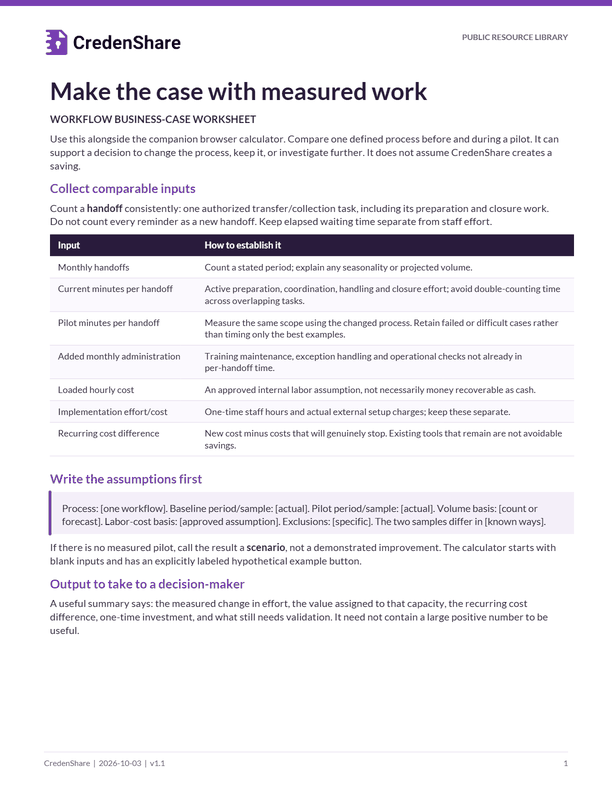
Make the case with measured work
WORKFLOW BUSINESS-CASE WORKSHEET
Use this alongside the companion browser calculator. Compare one defined process before and during a pilot. It can support a decision to change the process, keep it, or investigate further. It does not assume CredenShare creates a saving.
Collect comparable inputs
Count a handoff consistently: one authorized transfer/collection task, including its preparation and closure work. Do not count every reminder as a new handoff. Keep elapsed waiting time separate from staff effort.
| Input | How to establish it |
|---|---|
| Monthly handoffs | Count a stated period; explain any seasonality or projected volume. |
| Current minutes per handoff | Active preparation, coordination, handling and closure effort; avoid double-counting time across overlapping tasks. |
| Pilot minutes per handoff | Measure the same scope using the changed process. Retain failed or difficult cases rather than timing only the best examples. |
| Added monthly administration | Training maintenance, exception handling and operational checks not already in per-handoff time. |
| Loaded hourly cost | An approved internal labor assumption, not necessarily money recoverable as cash. |
| Implementation effort/cost | One-time staff hours and actual external setup charges; keep these separate. |
| Recurring cost difference | New cost minus costs that will genuinely stop. Existing tools that remain are not avoidable savings. |
Write the assumptions first
Process: [one workflow]. Baseline period/sample: [actual]. Pilot period/sample: [actual]. Volume basis: [count or forecast]. Labor-cost basis: [approved assumption]. Exclusions: [specific]. The two samples differ in [known ways].
If there is no measured pilot, call the result a scenario, not a demonstrated improvement. The calculator starts with blank inputs and has an explicitly labeled hypothetical example button.
Output to take to a decision-maker
A useful summary says: the measured change in effort, the value assigned to that capacity, the recurring cost difference, one-time investment, and what still needs validation. It need not contain a large positive number to be useful.
The calculations, without hidden assumptions
Let V be monthly handoffs; B baseline minutes each; P pilot minutes each; A added monthly administration hours; R loaded hourly cost; D recurring monthly cost difference; H one-time implementation hours; S one-time external setup cost; and N evaluation months.
| Result | Formula |
|---|---|
| Monthly capacity change | V × (B − P) ÷ 60 − A |
| Monthly modeled labor value | Capacity change × R |
| Monthly modeled net value | Modeled labor value − D |
| One-time modeled investment | H × R + S |
| Net modeled value over N months | N × monthly modeled net value − one-time modeled investment |
| Labor-valued break-even | One-time modeled investment ÷ monthly modeled net value, only when net value is positive |
These are original arithmetic conventions for this worksheet, not financial forecasts. A negative capacity change is a result to investigate, not a number to hide. The calculator retains it.
Keep cash separate
The browser tool also accepts monthly cash costs demonstrably avoided and new monthly cash costs, plus one-time cash outlay. It reports a separate cash-only balance. Do not copy labor value into cash avoided unless there is a documented actual cash reduction. Annual prepayment timing, tax, financing and discounting are outside this simple recurring comparison; use a dated cash schedule for those decisions.
Hypothetical example
120 handoffs/month, 12 baseline minutes versus 7 pilot minutes, 2 added admin hours, 60 units/hour loaded cost, 150 units/month extra recurring cost, 6 setup hours and 300 units external setup:
8 capacity hours/month; 480 labor-value units; 330 net modeled units/month; 660 one-time modeled units; 2 months labor-valued break-even. If monthly avoided cash is zero and new monthly cash expense is 150, the cash-only outcome is negative. Both statements can be true.
No currency or current CredenShare price is assumed by that example. Choose one currency and do not combine different currencies in the same calculation.
Decide what to do next
Run a small operational pilot
Choose the workflow, eligible participants and a representative case set before observing results. Track active minutes and failure reasons using the same boundaries in both periods. Capture authorization, completion and closure quality as well as speed. A faster process that bypasses an important control is not an acceptable improvement.
Interpret four possible outcomes
| Outcome | Practical response |
|---|---|
| Less effort, acceptable controls, positive modeled value | Consider a bounded rollout; validate the recurring workload and adoption assumptions. |
| Less effort, negative cash-only result | Decide whether capacity, control or service benefits justify the actual cash expense. Do not call it cash-neutral. |
| Little change in time, better documented process | Describe the non-time benefit directly and test whether it matters to the owner. Do not invent a cost saving. |
| More effort or repeated failures | Inspect the troublesome step, settings and recipient experience before expanding. |
Ready-to-use internal summary
We compared [workflow] across [baseline and pilot scope]. The observed active effort was [B] versus [P] minutes per case; [A] hours of additional monthly administration were included. At [V] cases/month this represents [capacity result], subject to [limitations]. The modeled labor-valued outcome is [result]; the separate cash-only outcome is [result]. We recommend [decision] and will verify [assumption] by [date/owner].
Sharing the result
Use the calculator's Print / Save PDF function after reviewing every input. The supplied tool stores inputs in page memory and makes no network calls; saving a report creates a local file you must handle appropriately. It does not send the calculation to CredenShare.
Keep sensitive business assumptions out of publicly shared screenshots. Mark hypothetical figures as hypothetical.
Related resources
Workflow review
Secure Credential Handoffs — Practical Report
Review one recurring handoff with practical procedures, fillable worksheets and a seven-day action plan.
Walkthroughs
Worked Workflow Walkthroughs
Click-through walkthroughs for collecting a customer credential, giving a contractor bounded access and preparing a diagnostic without the secret.